How to Read My Water Meter Cleveland Ohio
What is a Water Meter?
A water meter is a device that measures the book of h2o delivered to a property. Some water meters measure water in gallons while others mensurate in cubic feet.
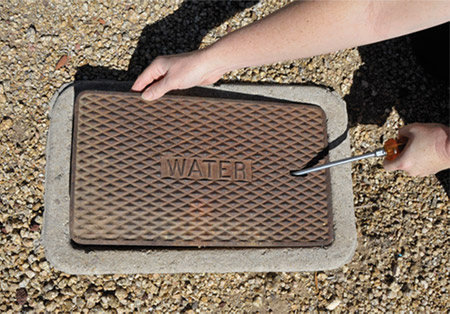
Most residential h2o meters are located near the curb or sidewalk at the front of the property in a physical "box." The water meter box volition take a metal or plastic lid and may be marked, "Water Meter."
Use a long screwdriver to remove the lid. Nonetheless, exist cautious as insects, reptiles or other small animals occasionally accept residence within the boxes. Some h2o meters volition have a pocket-size, hinged embrace while others may non. Lift the embrace and use a damp rag to wipe the face make clean.
Next
Adjacent
Some water providers lock the lids of residential water meter boxes. If this is the case, you may need to contact your provider or start with the visual inspections in Sections 2 and 3.
Understanding the Water Meter
Expect at your water meter to make up one's mind if you take an analog (punch) or a digital brandish. Instructions for reading both types of h2o meters are included in this section.
Reading the Analog Brandish
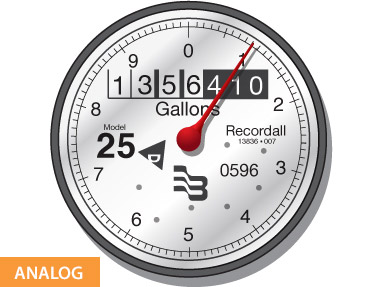
The large sweep manus on the punch measures water use in gallons or cubic anxiety. I gallon or one cubic foot of water passes through the water meter as the sweep hand moves from one number to the next (e.g., 0 to one). A complete rotation equals 10 gallons or 10 cubic feet depending on the unit of measurement measured. Most analog dials have a low-menstruation indicator that turns as water moves through the water meter. This typically looks like a pocket-sized triangle (shown), star or gear.
Analog Case: The sweep hand is on the "i" so the read is 1,356,411 gallons. The final number on the right is a static null (does non change). When the sweep hand is on the "iii" the read will exist 1,356,413 gallons. When you record your reading in the Leak Detection Test, make sure to employ the number indicated by the sweep arm as the final digit.
Activating and Reading the Digital Display (LCD)
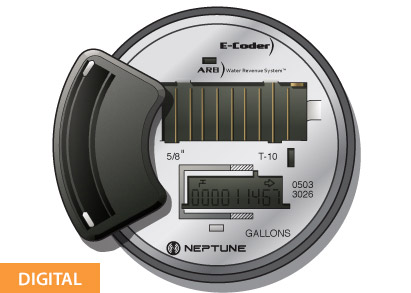
The digital meter needs light for activation and so you may demand to smoothen a flashlight on information technology. The display alternates betwixt the meter read and the flow charge per unit. The meter read equals the gallons (or cubic anxiety) used while the flow charge per unit equals the number of gallons (or cubic feet) per minute flowing through the water meter. Some digital meters permit review of historical water utilise. This feature helps runway water use trends such every bit when leaks take occurred. Check your h2o provider's website for more information.
Next
Adjacent
Homes in Phoenix measure water utilize in cubic feet (marked on dial confront). One cubic foot equals 7.48 gallons. Multiply the cubic feet by 7.48 to obtain the number of gallons.
Leak Detection Test
Once you know how to read your water meter, you can begin to check for the presence of continuous leaks by following the process beneath. Do not employ water or operate whatsoever water-using devices in or effectually your dwelling during the exam.
Stride-past-Footstep Instructions
For Analog Display Meters
- Observe the sweep hand. If information technology is moving, you take a continuous leak.
- Observe the low-flow indicator. If it is moving, y'all accept a continuous leak.
- Some leaks are so small that the movement is well-nigh undetectable. To determine if yous accept a ho-hum leak:
- Read your water meter and record the numbers in the boxes we've provided ("Fill in your meter readings Fill up in your meter readings"). Apply the number indicated by the sweep arm as the concluding digit.
- Await 20 minutes then read your h2o meter again and record the numbers.
- Subtract the kickoff h2o meter reading from the 2d.
- If Gallons Used is greater than null you lot have a continuous leak.
For Digital Display (LCD) Meters
- Observe the menstruation rate screen for at least 10 flashes. If the number is greater than zero on any of the flashes, yous take a continuous leak.
- Some leaks are very slow and may not show every bit a continuous flow. To determine if you accept a deadening leak follow Step iii above.
Next
Example of the presence of a continuous leak:
iind Read: - 1st Read: = Gallons Used:
Fill in your meter readings:
Wait 20 minutes between taking meter readings. Enter readings below to determine number of gallons used.
twond Read: - 1st Read: = Gallons Used:

Next
You may desire to confirm that no water use occurred during your exam, such equally a flushed toilet or faucet utilize. Other possible reasons for small amounts of water use include pool refill (autofill activated), evaporative cooler refill, icemaker refill, reverse osmosis (RO) organisation regeneration or water softener regeneration. Consider turning off their h2o supplies.
Methods to Detect the Location of Leaks
This guide provides 2 methods to detect the location of leaks: the Isolation Method and the Visual Inspection Method. A cursory clarification of both methods follows.
Isolation Method

The purpose of the Isolation Method is to isolate different sections of the plumbing in and effectually your dwelling house. If your Leak Detection Exam (Department 1) indicated a continuous leak, consider using the Isolation Method to discover the leak location. This is frequently the quickest manner to locate ongoing, hard-to-find leaks. Y'all will turn water supply valves "off" to forbid water from flowing into water supply pipes. If you are comfy turning valves on and off, go to Isolation Method for Continuous Leaks (Department four).
Visual Inspection Method
Conduct the Visual Inspection Method if you did not detect a continuous leak when y'all performed the Leak Detection Test (Department one) or if you are uncomfortable with the Isolation Method. Use the checklists in the Outdoor Visual Leak Inspection (Section 2) and Indoor Visual Leak Inspection (Section 3) to acquit visual leak inspections around your home.
Caution! Shut-off valves may neglect or break if they are old or corroded. You should only turn close-off valves past mitt.
Did You Know?
A 0.1 gallon per infinitesimal leak wastes 4,320 gallons per month.
That equates to as much every bit 51,840 gallons of h2o per year!
How to Read My Water Meter Cleveland Ohio
Source: https://www.smarthomewaterguide.org/how-to-read-your-water-meter
0 Response to "How to Read My Water Meter Cleveland Ohio"
Post a Comment